 |
 |
| Randy
became a confirmed horror movie addict
when his parents took him to see "The
Fly" in 1958. Growing up in the
1960's and '70s, Randy got a chance
to see tons of great horror films
on the big screen, and he used to
haunt local record stores asking for
horror movie soundtracks. Back then,
there were almost no horror soundtracks
(a compilation called "Themes
from Horror Movies" was about
the only such item commercially available).
Of course, things are much different
today, and Randy continues to collect
horror soundtracks. He especially
likes the work of composer |
|
|
|
James Bernard, who worked on many of Britain's
Hammer horror films.
Although
Randy was certainly aware of rock-&-roll
in the 1960's, it wasn't until the warped birth
of embryonic heavy metal--when Blue Cheer unleashed
"Vincebus Eruptum" in 1968, when 1969
vomited forth The Stooges' debut, and when Iron
Butterfly created the fuzzed-out "Iron
Butterfly Theme"--that Randy really sat
up and took notice. As soon as Black Sabbath's
first album appeared in record stores in February
1970, Randy grabbed it off the rack, not knowing
a thing about it. "It looked like it might
be scary", he recalled. When he put the
record on his turntable, it was like a nightmare-come-true.
"When I first heard those crushing doom
chords of the first song, 'Black Sabbath', I
sat in stunned silence," says Randy. "Here
was exactly what I always wanted, although I
didn't know I wanted it, because until it existed
I just couldn't have imagined it! It was like
horror movie music being played with heavy guitars
& tons of volume!"
Randy
bought all the metal albums that appeared in
the early '70s, including truly obscure stuff
such as Lincoln Street Exit, Night Sun, Sir
Lord Baltimore, and Buffalo. He began writing
material like "Child of Darkness,"
and soon joined Geof and Bobby in the 1974 version
of Pentagram.
Meanwhile, his love of horror movies led him
to start writing articles for monster magazines
such as "Famous Monsters of Filmland."
He eventually joined the magazine as a full-time
staff editor in the early 1980's. Working in
New York City, he also edited "Creepy,"
"Vampirella," "Eerie," and
a sci-fi comic magazine called "1994."
His articles also appeared in competitors' publications,
such as "Cinefantastique," "Filmfax,"
and "Fangoria." In 1997 he wrote his
first book, "Paul
Blaisdell: Monster Maker", published
in hardcover by McFarland. This was followed
by "Herschell
Gordon Lewis: Godfather of Gore" last
year (also from McFarland).
On
August 8th, 2002 we lost our good friend Randy
Palmer. We will continue to share Randy's music
and vision with Bedemon fans all over the world
through this website.
|
| |
 |
 |
It's
probably no coincidence that Geof
O'Keefe was born in Detroit Rock City,
home of some of his musical idols.
"Even though I didn't live there,
so much of the Motor City music scene
was an influence on me. Bands like
the Amboy Dukes, SRC, Dick Wagner
& the Frost, the Stooges, and
the MC5; that's what I grew up on."
O'Keefe
actually got his musical start while
living in Bangkok at age six, taking
up the ukulele. "I can't remember
a thing!" he says now. Later,
having
returned
to the
|
|
|
|
states
and
living in Indiana, he switched over to acoustic
guitar lessons at age eight, only to have them
end abruptly when his young instructor was killed
in a horrible car wreck with a train. "I'm
not sure I got that much out of the lessons.
My guitar playing's pretty much self-taught."
In the late sixties, his parents bought him
a cherry red Gibson Melody Maker and a Sears
Silvertone twin-twelve amp, both of which he
still owns to this day. "The Melody Maker
is the only electric guitar I've ever owned.
Every song I've written, every solo I've played,
has been on that guitar."
O'Keefe
is candid about his guitar abilities. "I
have no idea what I'm doing technically, but
I know how to play in key. I'm sloppy and repetitive,
but I think the passion slithers through. My
favorite solo so far is the middle one in "Time
Bomb." I play a lot these days. I'm getting
faster and wilder, and so is my guitar playing.
I know what excites me in a solo, and so I'm
trying to give that back to the Bedemon fans."
However,
O'Keefe is better-known as a drummer. "The
guitar is my favorite instrument to listen to;
but the drums are my favorite to play."
Geof
started out in the mid sixties by practicing
on KFC chicken tubs (!) and playing along to
Paul Revere and the Raiders and Dave Clark 5
records. It was during this period that he experienced
a tremendous weight gain. "I needed more
drums! Original Recipe for the toms, Extra Crispy
for the snare." O'Keefe soon moved up to
a Remco toy drum kit and eventually his first
"real" drums, a Gretsch set. "This
is what I used throughout most of Pentagram.
I had the set-up used by some of my favorite
drummers such as John Bonham and John Garner
(of Sir Lord Baltimore): single oversized bass
drum, single mounted oversized tom, two floor
toms and an extra-deep, super loud snare. I
was never a big fan of playing a double-bass
kit, although they do look cool on stage and
I did in fact use that set-up in my later bands,
Empire and Action. I used to cut the tips off
my drum sticks and round them off. I kept breaking
them anyway, so I figured why not? Eventually
I found some sticks that felt right and seemed
to last without the chopping, those being both
Pro Mark's Billy Cobham 808s and their Heavy
Soul 909s."
Geof's
father George was an executive at a direct mailing
warehouse in Alexandria, Virginia and this afforded
him the perfect place to practice and jam with
musician friends at night. Out of these late
sixties/early seventies gatherings came O'Keefe's
first band, the trio Space Meat. Led by the
virtuoso guitar playing, singing and songwriting
of John Jennings (later to go on to fame with
Mary Chapin Carpenter) and future-partner-in-Pentagram
bassist Greg Mayne, the band's all-original
material was a mix of Cream-jamming-styled hard
rock mixed with somewhat Neil Young-ish ballads,
all written by Jennings. They played high schools
and private parties in the Northern Virginia
area.
For
a brief period of time, Shades of Darkness vocalist
(and Geof's neighbor and good friend) Bobby
Liebling joined the band and the name was changed
to Stonebunny. However, this union didn't last
long and when Liebling left the band continued
under their original name, Space Meat.
Eventually
Space Meat broke up, due in part to the difficulty
of obtaining gigs while playing all original
material. O'Keefe and Liebling decided to start
from scratch and formed Pentagram, with Geof
switching over to guitar and fellow Wakefield
High student Steve Martin taking over the drumming
chores. Before long, Geof realized his place
was better suited on the drums, and Martin,
whose jazz influences were alien to the heavy
sound Pentagram was trying to formulate, left
the band. The classic Pentagram MK IV line up
of Bobby Liebling (vocals), Vincent McAllister
(guitar), Greg Mayne (bass) and O'Keefe on drums
finally fell into place on Christmas day, 1971.
This musically-rich-but-volatile quartet, expanded
to a five-piece during three separate periods
with the additional guitar of Bedemon's Randy
Palmer (twice, in '74 and '75) and Marty Iverson
('76) lasted through 1976 and three different
managers, recording three 45s and three demo
tapes (including one at CBS in New York, produced
by Murray Krugman and Sandy Pearlman of Blue
Oyster Cult/Dictators fame). "Egos and
drugs killed the band," says O'Keefe wistfully,
sipping his bottled water. More than one manager
abandoned us over the years mainly due to personal
conflicts," self-righteously adding, "I
wasn't one of the hard druggies, by the way."
It was during the band's later period in '76
that O'Keefe's songwriting began to blossom.
"I love Bobby's stuff," Geof states
emphatically. "It's brilliant and incredibly
fun to play, but it wasn't commercial in the
"verse/chorus/verse/chorus" way record
companies wanted. So I started writing material
more in the vein of Rainbow, Sweet, UFO and
so on." O'Keefe, McAllister and Mayne quit
Pentagram in early '77, and Geof and Vincent
went on to join Sex, a "supergroup"
which also featured Bret Reiss of The Boyz,
a band which coincidentally included future
Pentagram drummer Joe Hasselvander. Incredibly,
and despite his having written nearly all the
group's material, the band booted O'Keefe out
in favor of a technically more-proficient drummer.
With their setlist essentially gone and unable
to replace the O'Keefe-penned songs with their
own original material, Sex subsequently fell
apart in a few months. "Short-sighted fools,"
says the scorned drummer, betraying the slightest
hint of bitterness to this day, "that band
could've really gone somewhere but they blew
it."
While
not one to rest on his laurels, finding them
both uncomfortable and somewhat prickly, Geof
formed a new group which, for lack of a better
name, was called Sex II. Aside from O'Keefe,
the band was comprised of guitarists Norman
Lawson and Dave Kovel and bassist Vance Backus.
Sex II recorded a number of new O'Keefe songs
("Some of my best stuff!") in Vance's
basement but were unable to find a vocalist
and eventually disbanded.
Two
other bands followed in the first half of the
80s, Empire and Action, but neither contained
the magic of Pentagram or Sex ("...or Bedemon,"
adds O'Keefe, chuckling as he pops a grape in
his mouth while a hand-maiden fans him from
the side).
In
1988, O'Keefe moved from the D.C. area after
twenty-two years and headed to California, where
he resides to this day. "I meant to go
to Sweden but made a wrong turn." He was
a nighttime dj for six years at KOTR ("Afterglow"
hosted by Nightman) and has continued to write
for various outlets such as the record collector's
publication Goldmine
(his first piece was a lengthy article/interview
with Dickie Peterson of Blue Cheer in the May
23rd,1986 issue) and the jazz/fusion website
FUSE, in addition to selling records and music
memorabilia over the web (you can link to dozens
of O'Keefe writings and references by using
the Google
search engine and entering his full name).
He
finds the whole Bedemon phenomenon "mind-blowing."
"It's unbelievable that this little side
project is now getting this attention, especially
when I was putting all the effort into Pentagram!
But you know, it's fun. I love playing both
drums and guitar and writing songs, and our
goal with this new material is to make every
song a classic. No sucky piano ballads or anything.
Randy's got some killer new material like "Godless,"
Mike's working on some things and I've got at
least three new songs, one of which is "Ice
Queen," kind of like Captain Beyond-meets-Sabbath.
It will be way heavier than anything we did
before. Promise!"
|
| |
|
 |
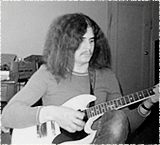
Mike
Matthews was hit over the head hard
with with the need to play screaming
guitar the first time he heard Jimi
Hendrix in 1969. Prior to that he
nearly got his family thrown out of
their apartment for incessantly pounding
drums as loud as possible. Fortunately
for Mike's mother, it was several
years before he could afford an amplifier
for his first guitar, an SG Special,
so he practiced either "dry"
or plugged into a record player.
|
|
|
|
Mike
was an army brat, born in Fort Dix, New Jersey.
The first 12 years of his life were spent moving
every year or two. After New Jersey, there was
a year in Georgia, a year in California, two
years in Beirut, Lebanon a year in Morocco,
a year in Pennsylvania, a year in Yemen, another
year in Pennsylvania, a year in Kansas and finally
in 1968 after his parents were divorced, the
travels ended for awhile in Arlington, Virgina.
It was in Arlington that Mike realized that
nothing was as cool as playing music, so he
started playing drums, guitar and bass and getting
seriously exposed to loud rock and roll.
While
working on the Bedemon project, Mike played
bass for a band called the Galactic 5, who played
originals and covers from groups like Gentle
Giant, Soft Machine, Pink Floyd and Savoy Brown.
That eclectic mix never went anywhere and soon
self-destructed, but valuable experience was
gained and Mike got together with local legend
guitarists, Chris Middleton and Eddie Cooper,
and keyboardist, Harold Smith, to form a new
band called "Jimmyproof Deadlock".
(God, who thought of these names?) This band
showed a lot of promise with two fine guitarists
playing lots of intricate harmonies and tight
rhythms, but came to a premature demise when
a riot broke out at a party they were playing.
As the police were arresting partygoers who
were hurling bricks through cop car windshields,
the band slipped out the basement door and Harold
Smith quit on the spot followed by everyone
else.
Mike
decided to get as far away from Arlington as
possible, so he moved to Seattle in 1979 to
attend the University of Washington. He also
decided to quit music and sold everything he
owned. About 2 months later, in Seattle, he
realized he was addicted to playing and formed
an acoustic duo called Breakfast of Champions
with Bruce Lindeke, a fellow U of W student.
Mike and Bruce played some originals and lots
of Grateful Dead, Asleep at the Wheel and even
some Hank Williams. Soon after came a sax player,
a bass player and a drummer. Mike wasn't really
cut out to play country so "the band had
a meeting", changed the format to loud
rock and roll, replaced Bruce with lead singer
Roger Wilkins in 1982 and the band's name was
changed to The Convertibles, with Mike now playing
lead guitar full time. The Convertibles stayed
together for 17 years and played in every club,
hotel and festival in the Seattle area, recording
7 or 8 originals, but mostly playing up-tempo
covers "real loud". In the mid 80's
to early 90's, the band was arguably the most
popular club band in Seattle and opened for
the Beach Boys and Three Dog Night. Things slowed
down for the Convertibles in the late 90's but
no one was really willing to stick a fork into
it until 1998 when Mike announced that he was
moving to Arizona because he was sick of the
rain.
Soon
after arriving, Mike formed the Mohave County
Five, the only rock and roll band in Kingman,
Arizona. In one short year the MC5 (not the
ones Geof grew up on) have gotten an original
played on the local radio station, starred in
a local televised telethon (is that redundant?),
and headlined the Mohave County Fair. Pretty
heady stuff...
Through
it all, the bottom line for Mike has been having
fun playing music and playing it real loud.
He expects to be playing as long as he can stand
up and hopes he will meet his demise on a stage
performing. He thinks getting back together
with his Bedemon brothers to kick out some more
mind crunching doom rock will really increase
the odds of that happening! Doom on!
|
| |
 |
 |
Craig
Junghandel (pronounced, yoong-hon-del)
first discovered his love for vocalizing
in his early twenties. It was at this
time that he began to cultivate, and
further his talent by jamming with
friends. Craig sang off and on in
various garage bands throughout his
twenties. After years of treating
his gift as a hobby, he finally felt
the need to get serious and form a
working band.
Craig wanted to form a cover band
that would pay tribute to some of
his favorite |
|
|
influences.
These would include: Black Sabbath, Judas Priest,
Iron Maiden, AC/DC, Alice In Chains, and many
others. With the help of a longtime friend, Wes
Beamer, they set out to form a band. After
recruiting the other would be members, (drummer,
Demmy Solario; guitarist, Ty Richardson; and bassist,
John Loomis) the band "Gauntlet" was
formed. Unfortunately, the project never left
the rehearsal room. Despite this fact, the band
played a significant role in Craig's future. Fortunately
for him, the band had managed to record one of
their practices on to a CD-R. It was soon after
this band's break up, that he would learn of Bedemon.
Through a mutual friend of Geof's, he was recommended
as a possible candidate for the 2002 material.
After talking with Geof about the new recordings,
he was very eager to be a part of Bedemon. After
listening to Craig's, "Gauntlet Demo"
(which consisted of four live takes of the following:
NIB, Behind the Wall of Sleep, Victim of Changes,
and The Ripper), Geof was definitely interested
in getting him in to record some of their material.
In order to demonstrate to Mike and Randy what
Craig was capable of, Geof had him add vocals
to five of the new Bedemon recordings, including
an all new rendition of, "Skinned".
Both Mike and Randy agreed with Geof's recommendation
of Craig as the new Bedemon singer, thus completing
the band.
Due to the tragedies that befell the band over
the past few years, Craig's recording of the new
material has only just now been scheduled for
fall of this year. However, he has been quite
busy though throughout this time. Craig has been
keeping his chops up by fronting his other band,
RISE.
"I am very eager to get to work on the 2002
recordings. Although Bedemon has been quiet for
the past few years, it is still very much alive.
I am truly honored to be a part of this new record." |
| |
 |
 |
|
